
A Magic Potion in Blackheath
By Miles Hedley
Here’s how to make a magic potion: take one hurdy-gurdy, stir in a dollop of drone with a liberal sprinkling of shawm, sackbut and rebec, add a soupçon of serpent, marinate in a jus of Ancient Greek and contemporary Korean spices, then serve piping hot. The result is enchantment and rapturous surprise. This feast for the senses was served up in Blackheath, from 12th to 15th November 2025 at the 52nd London International Festival of Early Music (LIFEM), and in the process, making this edition the best one yet.
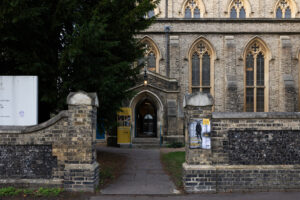
Over four days at Blackheath Halls and at the nearby church of St Michael and All Angels, those of us fortunate enough to attend were treated to a programme covering 2,000 years of musical history, from the Hellenistic world to the 21st-century phenomenon of K-pop, by way of medieval hymns, French court music and such Baroque giants as Bach and Telemann.
So let’s start with the hurdy-gurdy, a weird and wondrous gallimaufry of wheels, strings and keys that looks like a seriously ill-conceived attempt to cross a viol with a barrel organ. And yet, and yet… In the hands of the world’s best player, Tobie Miller, this bonkers box of tricks issued forth sounds of transcendent beauty that more closely resembled Yehudi Menuhin playing a Strad than the few grizzled old folkie players who made up my previous experience of this ancient instrument. It was the first of many glorious surprises served up during LIFEM25.
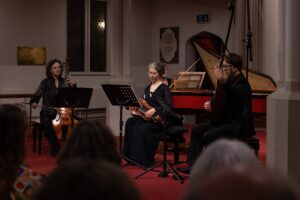
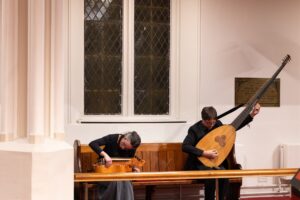
Miller is part of Ensemble Danguy with Caroline Ritchie (viola da gamba), Alice Humbert (harpsichord, baroque vielle) and Sam Chapman (theorbo, baroque guitar). Their sublime and hugely entertaining concert of 18th-century French music for the hurdy-gurdy opened the festival and set the bar terrifyingly high for those who had to follow. Listen for yourself here:
But follow they did – and maintained the exceptional standard. Day Two’s concerts began with a Junior Royal Academy of Music recital of works by women composers beginning with 12th-century genius Hildegard of Bingen. These young stars of tomorrow showed that the future of early music is safe in their hands.
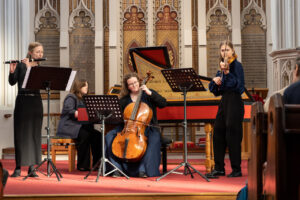
The lunchtime performance was by Polychroma, the winners of last year’s Young Ensemble Competition. Their programme of works by Locatelli and Leclair was appropriately titled Poise And Passion, both of which they had in spades. On the evidence of this recital, Anežka Drozdová (traverso), Natascha Pichler (violin), Glenna Curren (cello) and Marta Pindór (harpsichord) are going to wow the world.
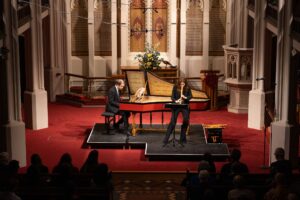
The evening was given over to international recorder superstar Dorothee Oberlinger, accompanied by harpsichord virtuoso Peter Kofler and what an evening it was. They began with Bach (who else?) before taking us on a mesmerising journey from the Baroque to the present that overflowed with unforgettable highlights, not least when LIFEM artistic director and recorder master Erik Bosgraaf accompanied her on his own composition D Für Dorothee Oberlinger, her amazing take on a Telemann sonatina, and the moment when Kofler suddenly ripped off his jacket to launch into Harald Feller’s Toccata as if he were a rock god like Keith Emerson. This wasn’t just a great recital, it was a great show.
Surprises at Every Turn
Talented young musicians from Caterham School kicked off Day Three at St Michael and All Angels before Telemann took centre stage with baroque violinist Zefira Valova. I’d always been aware of Telemann (obvs!), but until this recital, I had never properly appreciated just how great a composer he was, a greatness illuminated by Valova’s own brilliance in her solo interpretations and also in two lovely duets she played with Bosgraaf.
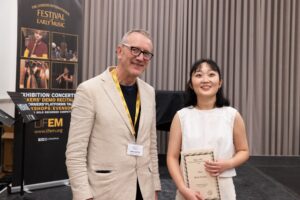
Down the road at Blackheath Halls, meanwhile, Eun Sol Lee was winning the Society of Recorder Players/Moeck Solo Recorder Competition. Her prize includes a date to perform at LIFEM 2026.
The Guildhall Cantata Project and the Academy of Ancient Music completed the day’s programme with a dazzling array of mostly 18th-century French music. It was a beautifully played and beautifully planned selection that took us from the Vulgate to the vulgar, the first half ending with Charpentier’s heartbreaking motet Le Reniement de St Pierre while the second half was given over to his wonderful operatic look at the vacuous hedonism of life at Versailles.
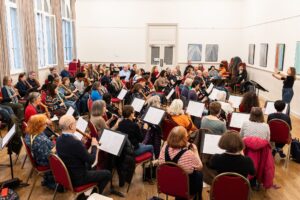
LIFEM’s programme is not just about concerts: it also offers a fascinating range of makers’ workshops and demonstrations. My own favourite this year was Musettes, The Bagpipe of Versailles, with revelatory performances by Amanda Babington and Bart Van Troyen. Like the hurdy-gurdy, the musette is an instrument that looks as if it has been invented by a mad professor but which has in fact evolved over centuries with more and more devices being added to extend its range. Also like the hurdy-gurdy, the noise it makes is unexpectedly melodious, providing yet another delightful surprise at the festival.
And, of course, there’s the makers’ exhibition in Blackheath Halls, with its mind-boggling array of historical instruments like the serpent, rebec, oboe da caccia, sultana, shawm, sackbut and crumhorn, as well as the astonishing sound of them being tried out by visitors so that the huge room throbs with strange music. It lifted my spirits every time I walked in.
A Finale to Remember
Another recorder virtuoso, Sarah Jeffery, launched the final day with Blast Off!, designed specifically for all the family. It was a first for LIFEM but judging by the reaction of the children, I doubt it will be the last. Using a range of recorders and some clever electronic gadgetry, Jeffery had them (and their parents) dancing in the aisles and shrieking with delight as she played, sang, chatted and whistled while leading them on a journey through space and time to a soundtrack that included a 2,000-year-old Greek song, cosmic works by the likes of Bach, Beethoven, Strauss and Holst, and even a blast of Kpop Demon Hunters. As if that wasn’t enough, every child was given a recorder to take home. I’m not sure I’ve ever seen such a joyful performance.
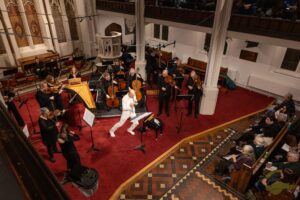
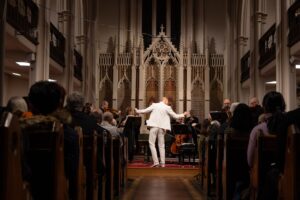
How on earth do you end a festival that has scaled the heights of excellence and entertainment as LIFEM25 has done? Erik Bosgraaf and the Wrocław Baroque Orchestra (WBO) provided the answer with a sensational concert of music by child prodigies Mozart and Vivaldi. With the white-suited Bosgraaf playing mainly a sopranino recorder and the orchestra featuring the fabulous Zefira Valova, we were treated to Mozart’s first symphony, written in London when he was eight, two adagios from when he was ten and his 20th symphony composed when he was 16. We also heard four concertos by Vivaldi. I can’t overstate how magnificent it was as these incredible musicians breathed new life into works that were already pulsing with the energy of genius. The glory of the evening was summed up for me in a series of passages in which Bosgraaf’s pyrotechnics were accompanied only by cellist Jarosław Thiel, the WBO’s artistic director. It was so moving yet so exhilarating. Hear a glimpse of that extraordinary sound here:
.
It was also an appropriately brilliant finale to a brilliant festival that keeps getting better and better. Bosgraaf, Chris Butler, Ann Barkway, Emma Lloyd, Eli Carr and their small but dedicated team should be very proud.