
This concert is included in the LIFEM Festival Pass and LIFEM Friday Day Pass.
Programme
Hernando de Cabezón (1541–1602) Dulce memoriae
Girolamo Frescobaldi (1583–1643) Canzon quinta à 3
Giovanni Bassano (1561–1617) Ricercata prima
Diego Ortiz (ca. 1517–ca. 1570) Recercada segunda sobre La Spagna
Costanzo Festa (ca. 1485–1545) Contrappunto 107 – Contrappunto 85
Giovanni Maria Trabaci (1575–1647) Canto fermo primo del primo tuono
Diego Ortiz (ca. 1517–ca. 1570) Recercada segunda sobre tenores italianos
Giovanni Maria Trabaci (1575–1647) Toccata seconda, & ligature per l’Arpa
Johann Schop (1590–1667) Lachrimae pavaen
Bartolomeo de Selma (1595–1638) Fantasia basso solo
INTERVAL
Jacob van Eyck (1589–1657) Daphne
Vincenzo Ruffo (1508–1587) La Brava – El Chiocho – La Danza
Claudio Merulo (1533-1604) Toccata settima
Giovanni Battista Fontana (1589–1630) Sonata decima à 3
Philipp Friedrich Böddecker (1607–1683) Sonata sopra La Monica
Bartolomeo de Selma (1595–1638) Vestiva i Colli passeggiato à 2
Antonio Bertali (1605–1669) Ciaccona
About L’Artefice • Capriccio et Invenzione
Capriccio et Invenzione — a symbiosis of playful virtuosity, and artful inventiveness. These principles are fundamental to the instrumental repertoires of the 16th and 17th centuries presented in this concert. Lavishly ornamented elaborations of vocal pieces, and intricate variations based on popular melodies stand beside compositions that we often think of as “purely instrumental” genres such as the Canzona, Ricercar, Toccata, or Sonata.
L’Artefice use their hands to create art with ingenuity and experience (just as the artificer from whom they take their name). Their work is inspired by the desire to add beauty and grace to the world we live in. Drawing on the past, the present, and imagining a future yet to come, they adapt, arrange, and create for their own instruments, breathing their own presence into these creations. Through this careful re-examining, reworking, rehearing of the sounds they create, they seek to foster deep connections – among one another, to their audience, and to the music itself.
Filip Rekieć works internationally as a baroque violin soloist, chamber musician and concertmaster. The diversity of his musical personality is reflected in his historically oriented playing, with his repertoire ranging from early baroque to romanticism and including instruments such as the fiddle and the nyckelharpa.
Italian-born Leonardo Bortolotto was exposed to music at a very early age, and learned to play the guitar and keyboard autodidactically. Later dedicating himself fully to music, he studied classical guitar and as an experienced chamber music player, consort violist, and solo performer, he accompanies his principal concert activities with passionate teaching, videography and audio engineering.
Vincent Kibildis is a harpist specialising in the music of the Middle Ages, the Renaissance and the Baroque. Their musical education began at the age of six on the Celtic harp, with a focus on Scottish and Irish traditional music, also integrating elements of bossa nova, jazz and world music into their playing. The constant search for new sounds and new ways of musical expression led them to early music and later to studies at the Schola Cantorum Basiliensis and the Escola Superior de Música de Catalunya with Mara Galassi.
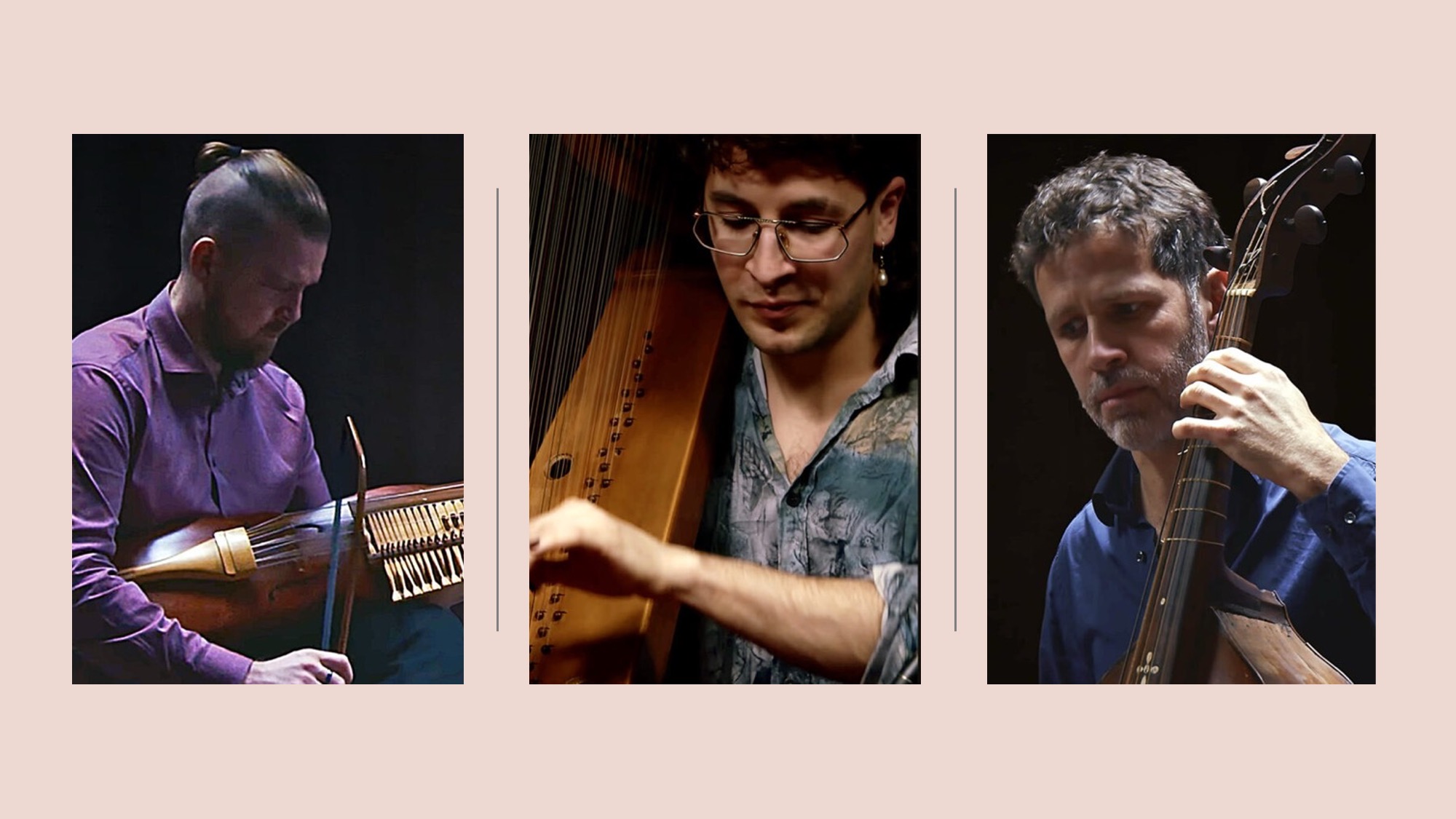
Filip Rekieć nyckelharpa, baroque violin
Leonardo Bortolotto bass viol
Vincent Kibildis harp